
UN agrees to review request to postpone LDC transition by 3 years
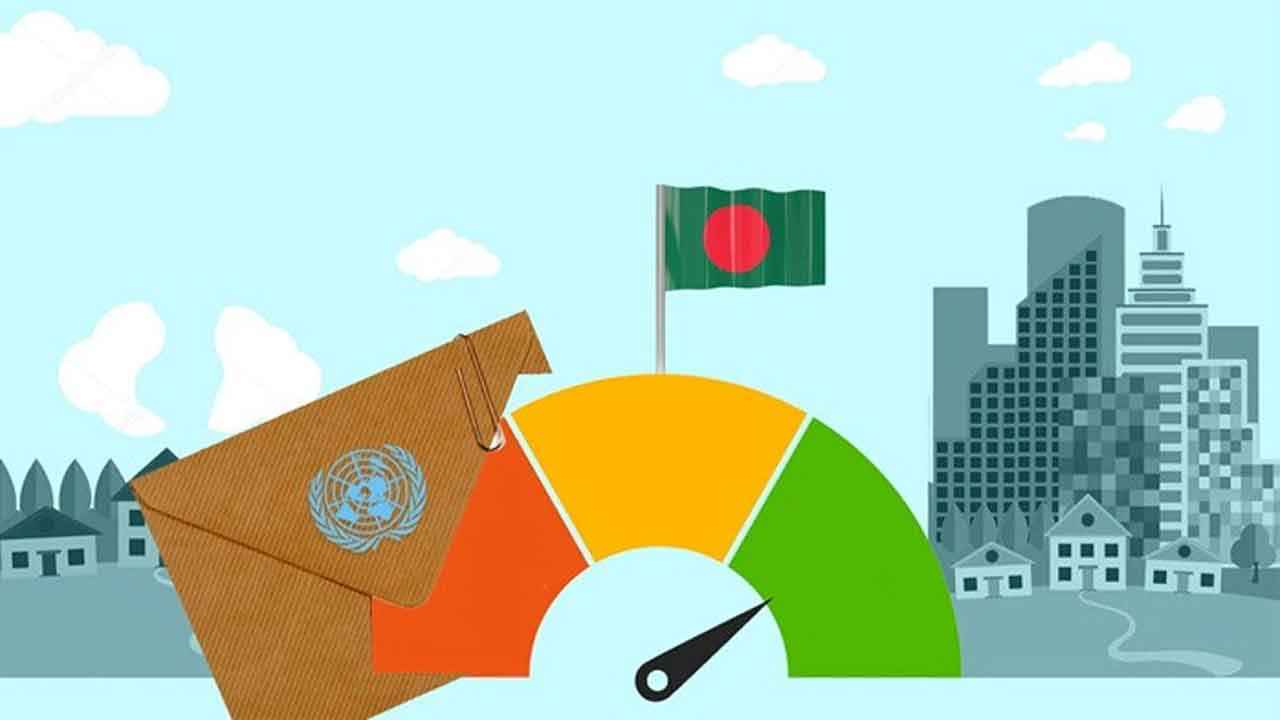 The United Nations has accepted Bangladesh's request to postpone its graduation from Least Developed Country (LDC) status by three years. The organization will now review the reasons given by the Bangladesh government for the postponement before taking a final decision.
The UN Committee for Development Policy (CDP) will review the application. The five-day meeting of the committee began in New York on February 23.
Debapriya Bhattacharya, a member of the CDP and head of its Enhanced Monitoring Mechanism (EMM) subcommittee, confirmed the matter.
Debapriya Bhattacharya said the committee has acknowledged receiving the letter sent by the Bangladesh government. However, accepting the application for review does not mean that the matter of postponing the transition from LDC has already been approved.
He added that the CDP will first examine the arguments raised by the government. Then they will send their recommendations to the United Nations Economic and Social Council (ECOSOC). From there, the matter will go to the UN General Assembly for a final decision.
The CDP member said it could take a few weeks to know the CDP's decision. It will then go to ECOSOC and the General Assembly in turn.
He also said that the CDP will verify whether Bangladesh is in crisis due to any 'unexpected and uncontrollable circumstances'.
Asked whether the committee would recommend postponing the transition, he said that nothing can be said about it until the process of reviewing the application is complete.
The EMM subcommittee is scheduled to meet this week to review the situation of countries that have already exited from LDCs and those awaiting graduation. Currently, Bangladesh, Nepal, and Laos are awaiting graduation.
Debapriya Bhattacharya said that one session will discuss the current status of Bangladesh, Nepal and Laos. It will examine how much progress these countries have made so far and how ready they are for the transition by the end of this year.
According to the current schedule, Bangladesh is scheduled to graduate from LDC status on November 24 this year. The third and final review process before graduation is now underway.
The day after taking office, the new government formally requested to postpone the transition until November 24, 2029. On February 18, a letter signed by Economic Relations Department (ERD) Secretary Md. Shahriar Quader Siddiqui was sent to CDP Chairman Jose Antonio Ocampo.
In the letter, Bangladesh noted that while the three conditions for transition—per capita national income, human capital index, and economic and environmental risk index—continue to be met, the five-year preparatory period has been severely disrupted by various global and domestic shocks.
The government cited the lingering impact of the Covid pandemic, the Russia-Ukraine war, tensions in the Middle East, the global financial crisis, and the slow recovery of international trade.
Internal factors have been cited as financial sector irregularities, the change of government in the July 2024 popular uprising, and ongoing pressure to provide shelter to displaced Myanmar citizens.
The letter said that these shocks have resulted in macroeconomic instability, reduced GDP growth, high inflation, reduced public and private investment. In addition, increased pressure on foreign exchange reserves, reduced imports of capital equipment and raw materials, and reduced investment have also slowed down the pace of new job creation.
In such a context, the letter states that the preparatory period could not be utilized as expected due to the government's policy focus shifting towards short-term stability and crisis management.
The government has also expressed concerns about trade risks post-LDC transition, including the risk of losing preferential trade benefits for ready-made garment exports to the European Union and the risk of possible retaliatory tariffs from the United States.
Using the crisis response provision under the EMM, Bangladesh has sought a three-year extension to stabilize the economy and complete priority tasks under its Smooth Transition Strategy.
Officials said a preliminary assessment report could be ready within two weeks of the February meeting. The CDP's observations and recommendations would be available later. A final decision is likely to be made by September, subject to approval by the UN General Assembly.
Editor & Publisher: Ziaul Hoq Mizan
Address : 3/2 Outer Circular Road (4th Floor), Rajarbag, Dhaka, Bangladesh
© All rights reserved by Daily Morning Herald - 2024-25 প্রিন্ট করুন
 সেভ করুন